

Discover What To NEVER Feed Your Cocker Spaniel - Plus Other Money, Time & Health Saving Tips From a Cocker Spaniel Insider.
If you're serious about your Cocker Spaniel and want the happiest, healthiest and most well behaved Cocker Spaniel on the block..... this might be one of the most important messages you ever read.
From:
Sharda Baker, 09.47
Dear Friend,
Hi my name is Sharda Baker and I'm bursting to share something with you.
There's an amazing new e-book on the Cocker Spaniel to assist you in having the absolutely best experience with your Cocker Spaniel. Without having to spend a small fortune and without having to spend hours grooming and training.
Are you maybe thinking of buying a Cocker Spaniel, not sure how to go about it, what questions to ask, how to look after and train your little friend?
Maybe you already own one or more Cocker Spaniels and want to make sure you care for your Cocker Spaniel properly? Cocker Spaniels, as you probably know by now, do require special care and once you learn and understand their needs its not that hard to care for a Cocker Spaniel. They are worth every bit of effort of course as they will reward you a hundred fold in enjoyment and unwavering companionship.
Don't make the mistakes many owners do though and presume a Cocker Spaniel is cared for the same way as any other dog. They aren't and that mistake could cost you dearly in time, money and heartache.
Maybe you just simply want to have your Cocker Spaniel trained a little better. A dog that pees inside, chews everything in sight, "pulls" on a lead, and barks too much can take some of the fun out of owning a dog can't it? And you know a Cocker Spaniel can easily be trained when you know how!
If some of this describes you and you would like a healthy, happy, well trained Cocker Spaniel that brings years of enjoyment for you and the family that doesn't end up costing you a small fortune please read on. It's frustrating to hear about Cocker Spaniel owners ending up with big disappointments just because they didn't have the right information at hand. There is a better way.
It's frustrating to hear about Cocker Spaniel owners ending up with big disappointments just because they didn't have the right information at hand. There is a better way.
This is what happened to me.
I remember the first puppy we bought , Shani. She was a pure bred 7 week old female . Her favorite sleeping place used to be in one of my husband's old leather shoes.
I didn't know then what questions to ask the breeder or what to look for when we went shopping for her. To cut a long story short we spent over $2700 on Shani over the first 2 years for 2 knee repairs and countless visits to the vet for on going allergy problems.
If only I had known then what I know today about Shani's diet, exercise and general needs we wouldn't have had to fork out all that money. and go through that stress. I guess in a way its a bit like buying a car. If you don't know what to look for can easily end up with a car that is not really in good condition .
Our second puppy "Ellie", we bought as a puppy when she was 16 weeks old. Puppies are so cute at that age aren't they? We didn't know how to tell if a puppy has been socialized well or not. Well, we got home with a dog that was real hard work for several months. Ellie was so timid, barked all the time, was very slow learning anything and took a while to take to any visitors. We leant the hard way again! But wow how things have changed now!
Our last few dogs have been almost perfect. OK they have been to the vet once or twice for their shots but we've had no major expenses in the last 6 years . We did our homework this time and had spent much of our spare time over the years finding out everything we could our dogs. It honestly has taken the worry and expense out of buying, training and caring for our dogs.
So Then I Decided
To write a book about dogs and share my experiences. My first dog book was on the Bichon Frise. It became quite popular on the internet and made me realize there are many other dog owners who have the same questions as me. It also gave me the confidence to leave my full time job and concentrate on my real love in life....dogs.
I now have published several successful dog e-books and I'm so excited about my latest, on the Cocker Spaniel.
Imagine This For A Minute.
Imagine being confident that you are asking the pet owner/breeder the right questions before you hand over your hard earned cash for you new "little friend". You don't want to end up withanything less than a healthy perfect little Cocker Spaniel do you?
And when you get home with your puppy, won't it be so nice knowing exactly what you need for your puppy in those first few months rather than "guessing"? Your role in the first 4 months is absolutely vital in developing a happy healthy Cocker Spaniel. Why risk making the mistakes so many other owners are making and paying for!
If you already own a Cocker Spaniel, I'm sure you want to know the answers to the common training, caring and breeding questions owners every day are asking? Questions that if unanswered may end up costing you literally thousands of dollars and can bring so much heartache.
Imagine knowing and mastering the simple training techniques that are unique" to Cocker Spaniels? Having a dog that is a pleasure to have inside the house at all times, that walks well on a lead, that's gentle with children and is really your best friend without costing a heap of money to look after.You'll be the envy of other dog owners too!
The Good News
I would love to help you have the best possible experience with your Cocker Spaniel. Having well trained dogs has certainly changed my life for the better! I want to help prevent you losing hundreds or maybe even thousands of dollars in health related costs by buying right and just as importantly caring for your Cocker Spaniel in the best possibly way. The right diet, exercise and care really make all the difference. A Cocker Spaniel does NOT have to be expensive to look after once you know what you are doing!
It 's my wish that you become one of the many happy Cocker Spaniel owners who are so proud when family or friends drop in and see their Cocker Spaniel. Won't it feel great to have your friends and other dog owners marvel at how well trained, healthy and well groomed your Cocker Spaniel is? There's nothing like seeing the effect a well behaved and well groomed Cocker Spaniel has on people is there!
To help make this happen for you a new e-book was written "The Complete A - Z Guide To The Cocker Spaniel"
In 119 pages I have covered nearly everything to help you have the best possible experience with a Cocker Spaniel from start to finish. It isn't like any other book you will ever read on the Cocker Spaniel either.
Why?
Apart from spending may months going through every bit of Cocker Spaniel information I could get my hand on, I interviewed several vets and Cocker Spaniel breeders to ensure I didn't miss anything.
I then passed on my completed ebook package onto several well respected Cocker Spaniel authorities and had them have their say on what else should be included in the ebook package.
Here's a sneak peak at what you'll discover in "The Complete A - Z Guide To The Cocker Spaniel"
- Learn how to choose your new family member. Never choose a Cocker Spaniel just because "they look cute in the shop window". It needs careful scrutiny, a lot of thought and a loads of information from the owner of the dog or the breeder you’re buying it from. It's worth it though as you will be hopefully then blessed the with years of enjoyment! (Discover clear detailed information on what you need to know)
- Find out all about the characteristics of the great Cocker Spaniel family. Most people are surprised to learn how the muscular physique of this breed came about! Knowing what to expect helps get and maintain a healthy Cocker Spaniel
- You will be amazed at what diet your Cocker Spaniel should be getting . Canned, dry and homemade food is all discussed in detail. (Everything about a Cocker Spaniel's dietary needs is clearly explained including the controversial BARF diet)
- Discover why if you’re thinking of owning a Cocker Spaniel, you will be first attracted to its gentle, alert, intelligent, sensitive and well mannered loving nature. Learn all about the temperament of the Cocker Spaniel and how to ensure you "pick" and train a Cocker Spaniel that has these characteristics. (not all do so be careful!)

- Learn How To Recognize a reputable Cocker Spaniel breeder. They should have a solid understanding of this breed and be willing and able to answer any of your questions. Learn what to look out for and what to ask!
- Breed Standards. Both experts and newcomers to the Cocker Spaniel will find our extensive explanations of the breed interesting and useful.
- Discover why and how after nutrition, exercise plays a very important part in the health of your dog. If yours is a city or county dog, exercise tips are discussed. Techniques of walking your "Cocker Spaniel" on a leash are explained. Discover exactly how to care for your Cocker Spaniel when you first get home. (Remember the first 4 months are the most important in the life of your dog)
IMPORTANT - Our REVEALING Cocker Spaniel Newsletter Report is NOW AVAILABLE. FREE - Don't Miss Out!
Once a week or so you'll receive a free email report that covers a Cocker Spaniel related topic.
There is no cost or obligation.
You can unsubscribe anytime.
Just enter your email address below for your FREE subscription now and get your free bonus report.
I dislike SPAM like everyone else!. Your email address is kept 100% confidential and will never be shared with anybody.

- Know how to groom your Cocker Spaniel from day one. Many owners use the wrong products which harm their Cocker Spaniel. (Once learnt properly grooming becomes much easier and fun!)
- Learn the importance of correct diet for your new puppy. So many owners get in wrong in the first few months and end up with a "finicky" eater for life. (vital detailed information provided)
- Tips for buying a Pup. Don’t be in a hurry: Learn all the important information to save you time and money.( Many people rush into buying a puppy without the proper knowledge and suffer the consequences for years).
- Discover the positive effects of early socialization. Cocker Spaniel are not as a rule an aggressive dog, but if poorly socialized you could end up with a "snappy" dog who tries to rule the household. (learn what to do from day one)
- Understand the "mentality" of your Cocker Spaniel. For instance, your Cocker Spaniel uses his eyes, mouth, voice, body and tail to communicate. (Training may take on a whole new meaning when you read this)
- If you’re in the process of bringing home a pup, it’s also time you explored the market for a good vet. Learn how to choose a good vet and understand ways to maximize your visit to the vet which may well end up saving you money.
- Be shown a useful list of internet resources. How do you know where to look for certain questions. (This may save you hours of frustrating searching)
- Discover how to teach your Cocker Spaniel to obey commands such as “sit,” or “down” or to come when called off-leash? To give your Cocker Spaniel the best you can, and to get the best from your Cocker Spaniel, you need to train him/her while they're at a very young age. (extensive proven techniques described in detail)
- Potty training finally de-mystified. In depth coverage given to this often misunderstood topic. (If your Cocker Spaniel is soiling the floor there is a proven training method inside that delivers)
- Understand just why to reduce the risk of disease in your Cocker Spaniel, it is best you have him vaccinated. As a pet owner, you have the choice of deciding which canine vaccinations you would want your pet to be given. (Clearly detailed vaccination regime outlined)
- Discover how to combat the number one problem among dogs of all breeds - poor dental care. Cocker Spaniels are no different (discover how to help prevent tooth disease by using a well balanced diet and chew bones)
- Did you know that dogs too can suffer from heart disease? Learn the signs to look for and what the treatment options are for a Cocker Spaniel. (Humans are not that different to dogs in many ways!)
- Find out the options to help your puppy through the teething stage. You will then have a much happier Cocker Spaniel. (A range of chew bones are discussed)
- Discover how if you are passionate about your pet, that pet medical insurance can save you money. Learn how each pet insurance company has its own pros and cons, you will have to scrutinize their health policies before going in for insurance. (Here’s what you need to check out)
- Understand all about crate training. Learn why this training method is not cruel and experience the difference it could make to your Cocker Spaniel. (Every owner will benefit from this information)
- Identify the easy grooming technique experts use. Due to their short hair that sheds minimally, Cocker Spaniel require a particular type of brush. (Step by step grooming is clearly explained)
- Learn the serious health illness Cocker Spaniels are very susceptible to in hot weather. Those cute short noses and dark, short coat can get your "best friend" in real trouble unless you are prepared.
- Discover how to set up an effective training program. Teach your dog to sit, come stay, roll over and more.
- Learn how to raise your Cocker Spaniel in a house filled with kids. Just as your Cocker Spaniel needs training, so do your children, so that they can understand the needs and moods of your pet. (Simple to follow guidelines that kids can easily remember)
- Learn the many benefits of spaying or neutering your Cocker Spaniel. You might be surprised the effect this has on your dog's health, mood and aggressiveness. (The risks of self breeding are also discussed)
- And that's just a fraction of what you'll find out in "Insiders Guide To A Happy, Healthy & Well Behaved Cocker Spaniel".
Here's what a few Cocker Spaniels owners had to say about my ebook.
 Dear Sharda,
Thank you for the ebook and the free bonuses.
I must say I found them all very interesting & extremely helpful.
Here is a photo of Coco our Cocker Spaniel puppy and I.
She is a lot better behaved now so thanks to your information
Kind Regards,
Jenny Wilson
West Yorkshire
United Kingdom

 Dear Sharda,
Just wanted to thank you so much for all the help I have received from reading your eBook on Cocker Spaniels.
I have already utilized so much valuable information that has aided in his training, and saved me money.
We haven't had a puppy for many years and had forgotten many things regarding training, grooming, and behavior solving problems.
Your eBook and free bonuses reminded me of much that I had forgotten, and is constantly teaching me new and better ways of dealing with this vibrant, energetic, little bundle of joy who has entered our lives.
I love your newsletters and helpful hints, they remind me that someone out there has done all of this before, experienced all of this before, and is able to guide us through the rough spots.
Thank you again Sharda.
This was one of the best tools I could have purchased along the way. It has already paid for itself in grooming costs alone.
We took our last dog to the groomer every month but with Rupert we groom him daily, only takes a few minutes, he is getting used to us doing that and doesn't seem to mind it too much.
The audio recording on training and behavior issues is most helpful as well.
Happy to report that he is responding well to commands
I am enclosing a picture of one of our grandchildren taken with our newest addition to the family.
This is Garrett and Rupert. It was love at first sight for Rupert with each and everyone one of them.
He has a beautiful, loving disposition, and I am sure your book and the valuable information I am gaining from it will aid in keeping him that way.
With our sincere thanks,
Nora and Ulysse Dupuis
Allanburg, Ontario
Dear Sharda,
Your ebook on the Cocker Spaniel has made training my pup so much easier, and at the same time made me feel confident that I was doing the correct things for 'Niles'.
The free bonuses are also terrific, especially the ones on allergies and the dog training audio. After downloading the audio, I saved it to a CD and have been playing it in the car. Niles is responding much better to me now that I realize I have to remind him that I am a the top of the pecking order!
His potty training took only 8 days and I will be sending you a photo soon.
I certainly would recommend you r ebook to other owners. It's really great value.
Sincerly,
Lindy and Derek Battersby.
Austin, Texas. USA
Dear Sharda,
I 'm 37 yrs. old and decided it was time for me to have a dog for the first time in my life, and I just knew that it had to be a Cocker Spaniel.
After a few days of realizing that finding and nurturing Cocker Spaniel puppy wasn't going to come naturally I started looking online for all the help I could find to understand and properly care for my new friend. As it turned out it was a short search for me to find the wonderful ebook package that you published Sharda.
The book is wonderfully written and so full of practical help along the way. One of my friends was incredibly impressed with the new knowledge that I had of Cocker Spaniels when he came to meet and I told him that I bought a book that had it all.
Your descriptions of behavior were so right on that it put me at ease and let me know what to expect. I found the crate training worked like a treat, and Emerson is responding to most of my commands already.
Thank You Sharda for providing such a wonderful tool for Cocker owners because without your help it's hard to know where to start to find and best care for a Cocker Spaniel.
Best regards,
Lee-Anne Thompson
Ca, USA
Hi Sharda,
I have been meaning to e-mail you about how your ebook has improved my life with my dog 'Beethoven' so much!
I have to give you my sincerest thanks for your E-book especially the freebie about being the Leader of your Dog's Pack.
That helped me like nothing else I have read about Cocker Spaniels and trust me I have read plenty!
The little tricks like walking out the door first and other tricks to show you are the dominant one, such as always eating ourselves first, have worked so well.
I initially just read it and said okay I will try it and it probably won't work like everything else I have tried.
To my astounding disbelief he started heeling and listening when I asked him to come.
Unbelievable ... I could not belief my eyes. And not only am I happier with my dog but dog Beethoven is happier then ever!
Thanks again
Trevor Lawrence
Pott's Point. Sydney. Australia.
Dear Mrs Baker,
I've owned Cocker Spaniels for over 13 years and have pretty well read everything out there. I still learnt many new and interesting things from your e-book and found the free dog grooming audio a great help.
Thanks also for the surprise bonuses you keep sending!
Thank you
Janine Emmerson
Ontario, Canada.
Sharda's disclosure.
The testimonials on this page are from real people and show the positive experiences they have had.
Not every customer can expect to or will achieve the same success and experiences as those listed on this page. Many customers fail to achieve these same results.
One of the main reasons not everyone achieves the same results is that in many cases they may not read the ebook or listen to the audios completely or they may not follow the information provided.
To achieve the best results for your dog, it is suggested you read all of the ebook and listen to any of the audios provided. You will then be in a better position to make the right decisions to best care for your dog.
The testimonials on this page are from real people and show the positive experiences they have had. Not every customer can expect to or will achieve the same success and experiences as those listed on this page.
Many customers fail to achieve these same results. One of the main reasons not everyone achieves the same results is that in many cases they may not read the ebook or listen to the audios completely or they may not follow the information provided.
To achieve the best results for your dog, it is suggested you read all of the ebook and listen to any of the audios provided. You will then be in a better position to make the right decisions to best care for your dog. Remember you are fully protected with my FULL refund guarantee.
"But what about all these other questions?"
You'll also get the answers to these and many more "in your face" questions:.
- "I have always wondered about the psychology behind training a dog. Can you explain this more for me?"
- "What papers should I be given when I buy a Cocker Spaniel?"
- "I had a friend with a lovely Cocker Spaniel. She told me they can have ear problems and even go deaf. Is this true?"
- "My son is 5 years old. Is he too young to care for a Cocker Spaniel?"
- "My Cocker Spaniel "digs up everything" in the garden , how can I teach him to stop it?"
- "Should I breed my Cocker Spaniel, are there any risks doing this?"
So, how much better would you feel knowing all the answers to these questions and more? Wouldn't you have a much better chance of owning a Cocker Spaniel that was well behaved , healthy and a integral part of your family.
That's why you should own this book today (in fact, you can be reading in as little as 5 minutes from now!). Don't you owe it to yourself, your family, and your dog?
What's a resource like this worth?
To have someone do all this research for you would normally cost you around $900 and take several months of research. This ebook package isn't some half baked collection of bits and pieces thrown together.
Everything is well researched, tested and clearly explained in PLAIN English. Which means it's dead-easy to read and understand. And it's logically laid out in great detail.
There are other resources out there retailing for up to $49.00
Which is why is such a bargain at only $31.77
That's right, a fraction of what it's really worth and what it cost me to research. Why would I make it so affordable? Simply because my costs to deliver it to you are so low.
This package is an electronic book, audio and ebooklets that can be downloaded to your computer in a flash. Which means you can be reading it and discovering all these amazing secrets in as little as 5 minutes from now. I think it's incredible and of course wouldn't have been possible not so many years ago.
No matter what however, it's a bargain for you. And yes, I plan on raising the price from $31.77 to $37.77 very soon.
So you'll want to be quick if you want to save some dollars.
And don't worry, if for any reason you're not happy with the content, you have a complete guarantee to protect your investment.
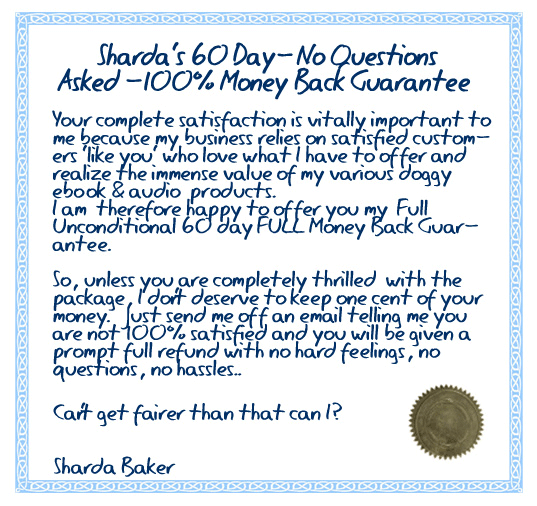
That's about as fair as it gets, don't you agree?
But I tell you what I'll also do to make this the best investment you ever make. I'm going to throw in some free bonuses which will help you even more..
So, if you invest in a copy of "The Complete A - Z Guide To The Cocker Spaniel" right now, here's what I'll also include for you.
***FOR A LIMITED TIME***
6 GENUINE FREE BONUSES
VALUED AT $73.44!
 FREE BONUS # 1 "Dog Training Down Secrets Revealed - Audio
This 53 minute audio is an interview with a well renown professional dog trainer who "has seen it all".
In this high quality recorded audio you will hear how a professional dog trainer manages the day to day dog behavior problems many dog owners have had to deal with. Basil will answer a long list of dog training questions I had put especially put together.
You will discover his proven methods of managing the disobedient dog, how to quickly control the dog that barks too much, potty training in as little as 24 hrs, step by step obedience training, and much much more.
The audio is 53 minutes long.
(RETAIL VALUE $ 27.97) FREE for a limited time for all those who purchase the "Complete A-Z Guide To The Cocker Spaniel" ebook package.
FREE BONUS # 2 Potty Training Made Quick And Easy - ebooklet
Potty or Housetraining can sometimes be hard work and cause stress in the home. You will need to have patience—and maybe even a sense of humor—as you train your poodle.
To make things easier and quicker, it's important from the beginning you have a clear plan and follow it.
This ebooklet provided a step by step approach to potty training for both the pup and the 'older' Cocker Spaniel. It covers crate training, paper training, litter box training, the ball method and the command method of potty training, plus much more.
You will discover genuine proven tips to quick and easy potty training.
(RETAIL PRICE $9.77) FREE for a limited time for all those who purchase the "Complete A-Z Guide To The Cocker Spaniel" ebook package.
FREE BONUS # 3 Managing The Barking Dog - ebooklet
A dog that is barking inappropriately can soon drive you and your neighbors a little crazy! This ebooklet outlines the easy steps you need to take to quickly control your barking dog.
It is written in a simple , clear and easy to follow format that is guaranteed to bring results fast or your money back.
(VALUE $9.99) FREE for a limited time for all those who purchase the "Complete A-Z Guide To The Cocker Spaniel" ebook package.
FREE BONUS # 4 Controlling Biting, Nipping and Jumping up - ebooklet
The dog who is already nipping then they should have their behavior managed quickly to prevent biting down the track. If you dog is already biting, measures should be undertaken now to help prevent a serious injury in the future.
This bonus ebooklet provides techniques to help teach your dog to STOP nipping, biting, or jumping up on visitors.
It is written in a simple , clear and easy to follow format that is also guaranteed to bring results fast or your money back.
(VALUE $7.95) FREE for a limited time for all those who purchase the "Complete A-Z Guide To The Cocker Spaniel" ebook package.
FREE BONUS # 5 Changing Your Cocker Spaniel's Temperament For The Better - ebooklet
What usually attracts many pet owner to a Cocker Spaniel is his/her appearance. Most buyers don't think about their Cocker Spaniel's temperament before its too late. This e-booklet offers vital information for Cocker Spaniel owners.
(RETAIL PRICE $9.77) FREE for a limited time for all those who purchase the "Complete A-Z Guide To The Cocker Spaniel" ebook package.
FREE BONUS # 6 All About Pet Insurance.
Is it worthwhile spending your hard earned cash on pet insurance? This ebooklet looks at the reasons for and against pet insurance so you are better able to decide.
(RETAIL VALUE $7.99) FREE for a limited time for all those who purchase the "Complete A-Z Guide To The Cocker Spaniel" ebook package.
The above FREE bonuses each worth every cent of their stated value. But , they're yours FREE. Congratulations!
Why Am I Giving Away So Many FREE Bonuses?
Well, there are 2 reasons I am offering such a large number of genuine quality free bonuses.
Firstly, I wish to over exceed your expectations and provide the best resources I can for you.
It make sense really, because with my 100% no questions asked refund policy, you can have a full 100% refund for up to 56 days, so I want you to love my package and tell other how helpful it was to you. Otherwise you can return it right back to me for your full refund.
Secondly, digital products do not require postage which means less overheads for me.
But I don't know how long I'll can keep these bonuses up there. So if you want them, I suggest you get in quick.

Truly wishing you great success with your Cocker Spaniel.
Warmly,

P.S.The Introductory low price of only $31.77 is a part of a market test I'm conducting. Once I've completed my market test, I know I'll be forced to put up the price to cover advertising costs. So if you're at all interested, you should buy right now.
P.P.S. Don't forget, you're getting a 119 page e-book for $31.77, PLUS 6 FREE bonuses valued at $73.44. You get the Complete A- Z Cocker Spaniel Guide ebook PLUS all the bonuses mentioned above.
This is all available right now for a limited time! So if that's what you want to do, this is the opportunity you've been waiting for.
P.P.P.S. You also have 56 days to review the e-book package and free bonuses and discover for yourself the value and benefits these books can provide to you.. You can easily get a refund at anytime during those 56 days and you even get to keep the e-book and FREE bonuses. You take absolutely no risk.
P.P.P.P.S DON'T FORGET MY SPECIAL LIMITED TIME OFFER.
For the NEXT 50 CUSTOMERS, I am including for FREE, 6 Bonus resources for your Cocker Spaniel.
That's $73.44 of genuine Complimentary bonuses just for trying my Cocker Spaniel ebook package.
See above for more details.
You better hurry to take advantage of this special offer before it expires.
Thank you for visiting.